Lith Corporation, founded in 1998 by a group of material science doctor from Tsinghua University, has now become the leading manufacturer of battery lab&production equipment. Lith Corporation have production factories in shenzhen and xiamen of China.This allows for the possibility of providing high quality and low-cost precision machines for lab&production equipment,including: roller press, film coater,mixer, high-temperature furnace, glove box,and complete set of equipment for research of rechargeable battery materials. Simple to operate, low cost and commitment to our customers is our priority.
Battery Coating Machine: A Comprehensive Introduction to Advanced Electrode Manufacturing Equipment
A battery coating machine is a critical piece of equipment in the modern lithium-ion battery production line, playing a decisive role in determining electrode uniformity, cell performance, and long-term operational stability. As battery technologies advance and demand for high-energy-density cells continues to rise, the precision and reliability of coating equipment have become more important than ever. This article provides a detailed overview of battery coating machines, including their features, working principles, processes, applications, and advantages within both industrial and research environments.
Overview
A battery coating machine is designed to evenly apply slurry—typically composed of active materials, binders, conductive additives, and solvents—onto metallic current collectors such as aluminum foil (for cathodes) or copper foil (for anodes). The purpose of coating is to ensure a controlled and consistent electrode layer thickness that directly influences battery capacity, internal resistance, cycling stability, and overall safety.
These machines are widely used in R&D labs, pilot lines, and mass production facilities for lithium-ion batteries, solid-state batteries, supercapacitors, and next-generation energy storage technologies.
Key Features
Battery coating machines incorporate several features that ensure maximum precision, stability, and repeatability:
1. High-Precision Coating Mechanism
Most machines utilize a slot-die or doctor-blade coating method, offering micrometer-level thickness control to guarantee uniform slurry distribution.
2. Stable Web Transport System
Advanced tension control systems maintain constant foil alignment and prevent wrinkling or stretching during coating.
3. Automated Drying Technology
Multi-zone hot air or infrared drying ovens ensure thorough solvent evaporation while preserving slurry morphology and preventing cracks.
4. Real-Time Monitoring and Feedback
Integrated sensors, camera systems, and control algorithms continuously adjust coating parameters, ensuring consistent product quality.
5. Safe and Energy-Efficient Operation
Systems often include solvent recovery units, explosion-proof designs, and thermal optimization to comply with environmental and safety standards.
Coating Process and Working Principle
The fundamental principle of a battery coating machine is the controlled deposition of slurry onto a moving foil substrate. The process generally includes the following stages:
1. Slurry Feeding
The prepared electrode slurry is fed through a precision slot-die head or applied with a doctor blade. Flow rate and viscosity control are crucial to achieving stable output.
2. Uniform Application
The coating head spreads the slurry onto the foil at a defined gap. The coating width, thickness, and loading density are adjusted through automated machine settings.
3. Drying and Solvent Evaporation
The coated electrode passes through a multi-zone drying oven. Each zone maintains specific temperatures and airflow rates to gradually remove solvent without damaging the electrode structure.
4. Cooling and Tension Control
After drying, the foil is cooled and rolled under stable tension before further processes such as calendaring or slitting.
5. Quality Inspection
The machine may include inline sensors that measure thickness, weight, and coating defects, ensuring each batch meets rigorous standards.
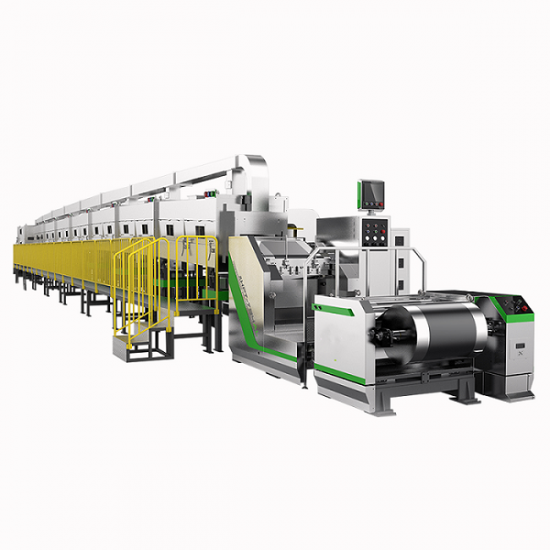
Battery Coater
Applications
Battery coating machines are essential for a wide range of energy-related technologies, including:
* Lithium-ion batteries for consumer electronics, electric vehicles, and energy storage systems
* Solid-state batteries, where uniformity is crucial for solid electrolyte layers
* Lithium–sulfur and lithium–metal battery research, requiring precise coating for novel cathode materials
* Supercapacitors, which rely on consistent active material distribution for high power output
* Pilot-scale and academic research labs, where small-batch coating precision is necessary for experimental development
Advantages
Battery coating machines provide multiple technical and operational advantages, making them indispensable for advanced electrode manufacturing:
1. Enhanced Coating Uniformity
Precise thickness control ensures consistent electrochemical performance across the electrode surface, improving battery capacity and cycling stability.
2. High Production Efficiency
Automated systems support continuous coating, significantly increasing throughput while reducing manual labor.
3. Versatility for Different Materials
Machines can handle a wide range of slurries, including NCM, LFP, LCO, graphite, silicon-based anodes, and emerging materials.
4. Reduced Material Waste
Optimized slurry flow control minimizes coating defects and overuse of active materials, leading to cost savings.
5. Superior Reproducibility
Digital parameter control and real-time monitoring ensure consistent quality across multiple production batches.
6. Adaptability to R&D and Mass Production
From benchtop lab coaters to fully automated large-scale systems, the technology can be tailored to different production requirements.
Conclusion
The battery coating machine stands at the core of modern electrode manufacturing, ensuring precision, efficiency, and uniformity in the production of advanced energy storage devices. As battery technologies evolve and the global demand for high-performance cells continues to grow, the importance of reliable, high-precision coating equipment will only increase. Whether used in research labs or industrial mass-production lines, battery coating machines are indispensable for delivering consistent and high-quality electrode materials that meet the stringent requirements of today’s battery industry.


 Online service
