Lith Corporation, founded in 1998 by a group of material science doctor from Tsinghua University, has now become the leading manufacturer of battery lab&production equipment. Lith Corporation have production factories in shenzhen and xiamen of China.This allows for the possibility of providing high quality and low-cost precision machines for lab&production equipment,including: roller press, film coater,mixer, high-temperature furnace, glove box,and complete set of equipment for research of rechargeable battery materials. Simple to operate, low cost and commitment to our customers is our priority.
Doctor Blade – Professional Mechanical Equipment Introduction
A doctor blade is a precision coating and metering device widely used in film fabrication, battery electrode manufacturing, printing, adhesives, ceramics, pharmaceuticals, and functional material research. By controlling the thickness and uniformity of wet films, the doctor blade plays a crucial role in ensuring product consistency, highquality surface finishes, and stable process repeatability. Its simple yet highly engineered structure allows precise control of thinfilm deposition, making it indispensable in laboratory research and industrial production.
1. Concept of the Doctor Blade
The doctor blade is a mechanical tool designed to spread, meter, or remove excess liquid or slurry from a substrate surface. It works by maintaining a fixed gap between the blade edge and the substrate, guiding the material into a uniform thickness during coating. In advanced manufacturing fields—such as lithiumion and sodiumion batteries—the doctor blade ensures precise electrode film formation, directly affecting electrochemical performance and overall device quality.
By adjusting the blade height, angle, or coating speed, users can achieve film thicknesses ranging from a few micrometers to several hundred micrometers, enabling versatility across various coating tasks.
2. Structural Design
A doctor blade typically consists of several key structural components designed for precision, stability, and durability:
• Blade Body
Usually made from stainless steel, hardened steel, ceramic, or tungsten carbide to ensure wear resistance and corrosion protection.
• Adjustable Gap Mechanism
Manual micrometers, screw knobs, or digital actuators control the coating gap with precision often reaching 0.01 mm.
• Holding Frame or Blade Holder
Provides structural support and maintains blade straightness across the coating width.
• Guiding Rails or Support Platform
Ensures smooth and stable movement over the substrate, preventing vibration and ensuring consistent coating thickness.
• Optional Heating or TemperatureControl Module
Used when slurries require controlled viscosity or when working with sensitive polymeric materials.
• Substrate Fixation System
Vacuum plates or clamping devices hold the substrate flat for highuniformity coating.
The combination of these structures allows the doctor blade to maintain micronlevel accuracy throughout the coating process.
3. Key Characteristics
• High Precision
The doctor blade can produce highly uniform films with minimal thickness deviation.
• Wide Material Compatibility
Suitable for ceramics slurries, battery slurries, conductive inks, polymers, adhesives, and nanoparticle suspensions.
• Adjustable and Flexible
The blade gap, coating width, coating speed, and blade angle can all be finetuned to match process requirements.
• Durable Construction
Highstrength blade materials resist abrasion during continuous coating of particulate slurries such as cathodes and anodes.
• Simple Operation
Userfriendly design enables researchers and manufacturers to achieve reliable results with minimal setup.
4. Coating Process
The doctor blade coating process generally follows these steps:
1. Substrate Preparation
The substrate is cleaned, dried, and fixed onto the coating platform.
2. Blade Adjustment
The operator sets the coating gap, selects blade angle, and configures speed parameters.
3. Slurry Loading
Material is poured in front of the blade.
4. Film Formation
As the blade moves forward, it spreads the slurry into a uniform film at the preset thickness.
5. Drying or Curing
The wet film may undergo thermal drying, UV curing, or solvent evaporation depending on material properties.
6. PostProcessing
Cutting, calendaring, sintering, or lamination may follow, depending on the application.
This controlled process ensures repeatable film thickness and smooth surface morphology.
5. Industrial Applications
Doctor blades are widely used in:
• Battery Electrode Manufacturing
Coating activematerial slurry onto aluminum or copper foil for lithiumion and sodiumion batteries.
• Functional ThinFilm Fabrication
Preparation of ceramic tapes, polymer electrolyte films, separators, and dielectric layers.
• Research Laboratories
Producing experimental films for materials science and chemical engineering studies.
• Printing and Graphics Industries
Controlling ink transfer in gravure, flexographic, or screen printing.
• Adhesive and Coating Production
Applying uniform adhesive layers, sealing coatings, or protective functional coatings.
• Electronics and Optical Devices
Creating conductive layers, optical films, and sensor coatings.
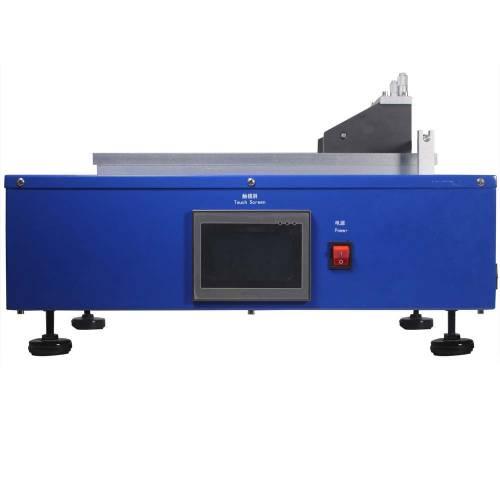
Doctor Blade Coater
6. Advantages
• Excellent Thickness Control
Provides reliable film uniformity essential for advanced materials and precision engineering.
• High Versatility
Compatible with multiple fluids, substrates, and coating environments.
• CostEffective Solution
Compared with complex automated systems, doctor blades offer precise results with lower operating costs.
• Easy Maintenance
Simple structure allows fast blade replacement, cleaning, and calibration.
• Scalable From Lab to Industry
Doctor blade technology can be applied to smallscale research setups or fully automated industrial coating lines.
• Enhanced Product Quality
Uniform film surfaces improve mechanical strength, conductivity, optical clarity, and electrochemical performance.
Conclusion
The doctor blade is a highly adaptable, precise, and reliable coating tool widely used in thinfilm manufacturing and materials research. Its robust structure, adjustable design, and excellent coating performance make it an essential device for producing consistent, highquality films in industries ranging from batteries and electronics to ceramics and coatings. Through its precise metering capability, the doctor blade continues to play a critical role in advancing material engineering and modern fabrication technologies.
• Control Interface
Digital display, PLC controller, or touch panel for setting parameters such as coating speed, pressure, and travel distance.
• Optional Heating or Vacuum Modules
Some models include temperaturecontrolled platforms or vacuum beds to secure delicate substrates and support temperaturesensitive coatings.
3. Key Characteristics
• High Precision Thickness Control
Film thickness can be controlled within ±1–5 µm depending on the applicator design and coating conditions.
• Wide Material Compatibility
Suitable for viscous slurries, lowviscosity liquids, inks, binders, adhesives, ceramic slurries, polymer solutions, and electrode pastes.
• Smooth and Consistent Film Surface
Uniformity is ensured through stable coating geometry and steady coating speed.
• Flexible Configurations
Available in manual bars, adjustable doctor blades, wire rods, and programmable automatic coaters to meet diverse coating needs.
• Stable and Repeatable Operation
Automatic models eliminate human variability, supporting highprecision research and production processes.
4. Process Technology
The coating process conducted with a film applicator typically includes the following steps:
• Material Preparation
Mixing, filtering, and adjusting viscosity to ensure stable flow behavior during coating.
• Substrate Preparation
Cleaning, drying, or pretreating the substrate to ensure adhesion and uniform wetting.
• Setting Coating Parameters
Adjusting blade gap, coating speed, pressure, and travel distance based on target film thickness.
• Film Application
The applicator bar moves across the surface, spreading material and forming a controlledthickness wet film.
• Drying or Curing
The coated film undergoes thermal drying, UV curing, or solvent evaporation to achieve its final properties.
This process simulates industrial techniques such as slotdie coating, rolltoroll coating, or doctorblade spreading, enabling laboratoryscale formulation optimization.
5. Applications
Film applicators are widely used across many industries and research fields:
• Battery Electrode Manufacturing
Coating cathode and anode slurries onto current collectors for lithiumion or sodiumion batteries.
• Paints, Coatings, and Inks
Testing color uniformity, gloss, drying behavior, and adhesion properties.
• Adhesives and Sealants
Evaluating curing performance, viscosity, and bonding characteristics.
• Polymer and Composite Materials
Forming thin films for material testing, optical evaluation, or barrierproperty measurement.
• Electronics and Functional Materials
Applying conductive inks, dielectric pastes, and nanomaterials onto substrates.
• Research and Education
Used in labs for formulation development, quality control, and process optimization.
6. Advantages
• Excellent Coating Uniformity
Ensures reproducible film thickness and high surface quality for precise evaluation.
• High Efficiency and Repeatability
Automatic applicators provide stable coating results across multiple samples.
• Versatile Configurations
Supports various materials, thickness ranges, and substrate types.
• Reduced Material Waste
Precise gap control minimizes excess slurry usage and improves experiment efficiency.
• Scalable for Industrial Production
Laboratory results can be directly transferred to pilotscale and industrial coating systems.
• Enhanced Experimental Control
Adjustable parameters allow researchers to systematically study material behavior under controlled coating conditions.
Conclusion
The film applicator is a vital tool in modern coating technology, offering precise control over film thickness, material distribution, and coating uniformity. Its robust structural design, versatile coating capabilities, and ability to handle diverse materials make it indispensable in battery research, material sciences, coating formulation, and industrial quality control. Whether used for scientific experimentation or preproduction testing, the film applicator ensures repeatable, accurate, and highquality coating results essential for advanced manufacturing and research applications.


 Online service
