Lith Corporation, founded in 1998 by a group of material science doctor from Tsinghua University, has now become the leading manufacturer of battery lab&production equipment. Lith Corporation have production factories in shenzhen and xiamen of China.This allows for the possibility of providing high quality and low-cost precision machines for lab&production equipment,including: roller press, film coater,mixer, high-temperature furnace, glove box,and complete set of equipment for research of rechargeable battery materials. Simple to operate, low cost and commitment to our customers is our priority.
Dr Blade: Overview, Features, Process, Applications, Advantages, and Conclusion
The dr blade, also known as the doctor blade, is a precision coating device widely used in laboratories and industrial manufacturing to create uniform thin films of slurries, pastes, or liquid materials. This equipment is essential for producing controlled‐thickness coatings on substrates such as metal foils, glass, and polymer films. The dr blade technique is particularly valued in research fields including battery electrode development, ceramic tape casting, printed electronics, and advanced material fabrication.
Overview
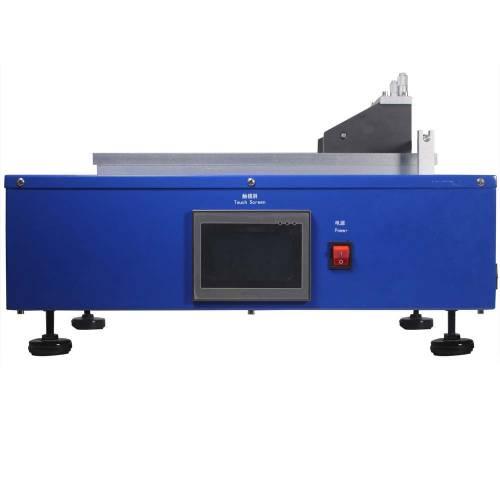
A dr blade system functions by drawing a calibrated blade across a substrate to spread material evenly. The blade height determines the wet film thickness, while the uniform motion ensures a homogeneous coating layer. The dr blade is simple in structure yet highly effective, making it a core instrument for both laboratory testing and small‐scale production.
Key Features of the Dr Blade System
Modern dr blade coaters incorporate several advanced features that enhance accuracy, repeatability, and process flexibility:
Adjustable Blade Gap: The blade gap can be precisely tuned, typically from micrometers to millimeters, allowing control over coating thickness.
Stable Coating Speed: Motorized systems provide consistent coating speeds for high uniformity across large substrates.
Interchangeable Blades: A variety of blade materials—stainless steel, ceramic, or Teflon—can be used depending on the coating slurry.
Heating Platforms (Optional): Some devices include temperature‐controlled stages for drying or curing during coating.
Wide Substrate Compatibility: Suitable for metal foils, polymer films, ceramics, and glass sheets.
Dr Blade Coating Process
The dr blade coating process typically involves several critical steps:
Substrate Preparation: The substrate is cleaned and secured on the coating platform to ensure adhesion and smoothness.
Material Dispersion: The slurry, paste, or liquid is deposited in front of the blade.
Blade Adjustment: The gap between the blade and substrate is set to achieve the target thickness.
Uniform Coating: The blade moves across the substrate at a controlled speed, spreading the material evenly.
Drying or Curing: The coated film is dried naturally or heated to solidify the coating.
Post-Processing: The dried layer may undergo calendaring, sintering, or cutting depending on application requirements.
This process ensures reproducibility and high precision, making it ideal for material testing and pilot-scale manufacturing.
Doctor Blade Coater
Applications
The dr blade technique is widely applied in numerous advanced material and manufacturing sectors:
Battery Electrode Fabrication: Creating uniform cathode and anode layers for lithium-ion, sodium-ion, and solid-state batteries.
Ceramic Tape Casting: Producing thin ceramic layers for capacitors, sensors, fuel cells, and structural ceramics.
Printed Electronics: Coating conductive inks, dielectric materials, and functional films.
Solar Cell Fabrication: Depositing thin layers for perovskite and organic photovoltaic cells.
Membrane Materials: Applying uniform coatings for filtration and separation technologies.
Coating Research & Material Development: Testing new formulations of paints, slurries, and functional coatings.
Advantages
Using a dr blade offers a number of significant advantages:
High Precision Thickness Control: Enables exact wet film thickness, critical for battery and electronic materials.
Excellent Uniformity: Produces smooth, defect-free coatings across large areas.
Low Material Waste: Efficient spreading minimizes slurry consumption, ideal for expensive research materials.
Flexible and Adjustable: Suitable for various viscosities, substrates, and coating parameters.
Scalable Process: Laboratory results can be easily scaled to industrial coating systems.
Cost-Effective: Simple structure and easy operation make it economical for research facilities.
Conclusion
In conclusion, the dr blade is a versatile and indispensable tool for creating precise, uniform thin films in both research and manufacturing environments. With adjustable blade gaps, stable coating speeds, and compatibility with diverse materials, it supports critical applications including battery electrode production, ceramic tape casting, printed electronics, and advanced material development. Its accuracy, flexibility, and cost‐effectiveness make it one of the most reliable coating technologies available. As industries continue to advance toward thinner, more complex functional films, the dr blade remains a foundational technology for achieving consistent, high-quality coatings.


 Online service
