Lith Corporation, founded in 1998 by a group of material science doctor from Tsinghua University, has now become the leading manufacturer of battery lab&production equipment. Lith Corporation have production factories in shenzhen and xiamen of China.This allows for the possibility of providing high quality and low-cost precision machines for lab&production equipment,including: roller press, film coater,mixer, high-temperature furnace, glove box,and complete set of equipment for research of rechargeable battery materials. Simple to operate, low cost and commitment to our customers is our priority.
Film Coating Applicator: Overview, Features, Process, Applications, Advantages, and Conclusion
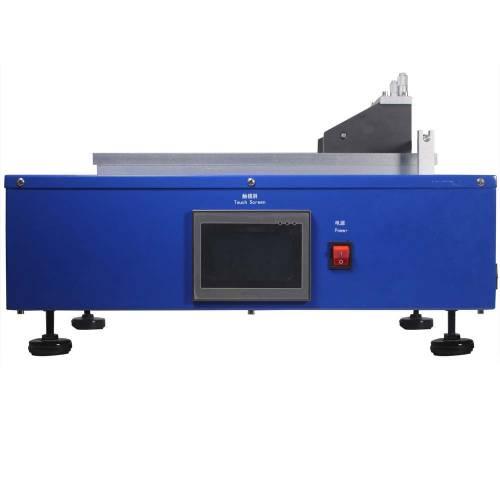
A film coating applicator is a precision device designed to apply uniform thin films of liquid, slurry, or paint onto various substrates. Widely used in laboratories, research facilities, and industrial production lines, film coating applicators are essential for evaluating material performance, ensuring reproducibility, and achieving high-quality coatings in industries such as electronics, batteries, printing, packaging, and coatings.
Overview
The film coating applicator operates by spreading a controlled layer of liquid material evenly across a substrate using calibrated blades, rollers, or other coating mechanisms. This equipment ensures precise control over film thickness, uniformity, and surface quality. By standardizing the coating process, film coating applicators help researchers and manufacturers reduce variability, optimize formulations, and maintain consistent product performance.
Key Features of Film Coating Applicators
Key features of modern film coating applicators include:
Adjustable Film Thickness: Precise control over coating thickness to meet testing or production requirements.
Versatile Substrate Compatibility: Suitable for metal foils, glass, plastic, paper, and other surfaces.
Uniform Coating: Ensures smooth, defect-free films across the entire substrate.
Manual and Automated Operation: Supports small-scale laboratory work and high-throughput industrial applications.
Precision Blade or Roller Mechanisms: Calibrated components provide consistent and even spreading of materials.
Easy Maintenance: Simplified cleaning and blade replacement for different materials and formulations.
Coating Process
The typical process using a film coating applicator involves:
Substrate Preparation: Cleaning and drying the substrate to ensure proper adhesion of the coating.
Material Loading: Applying the liquid, slurry, or paint onto the substrate.
Film Application: The coating material is spread evenly using a calibrated blade or roller to achieve the desired thickness.
Drying or Curing: The coated substrate is allowed to dry naturally or cured under controlled conditions depending on the material.
Inspection and Testing: The final film is evaluated for uniformity, thickness, adhesion, surface finish, and other performance characteristics.
Automated film coating applicators allow for continuous operation, precise parameter control, and high reproducibility, simulating industrial coating processes on a smaller scale.
Tape Casting Coater
Applications
Film coating applicators are widely used in:
Battery Manufacturing: Applying thin coatings to electrodes for lithium-ion, sodium-ion, and other advanced batteries.
Printed Electronics: Producing conductive, dielectric, and semiconductive films.
Paints and Coatings: Laboratory testing and small-scale production of paints, varnishes, and functional coatings.
Flexible Electronics: Coating films and foils for displays, sensors, and solar cells.
R&D and Quality Control: Evaluating material properties, optimizing formulations, and maintaining consistent product quality.
Advantages
The main advantages of film coating applicators include:
High Precision and Reproducibility: Ensures uniform films for reliable testing and production.
Versatility: Compatible with a wide range of substrates and coating materials.
Efficiency: Reduces material waste and speeds up the coating process.
Scalability: Laboratory results can inform pilot-scale or full-scale production.
Quality Assurance: Enables the production of smooth, defect-free coatings essential for advanced applications.
Ease of Use: Simple operation and maintenance for both lab and industrial environments.
Conclusion
In conclusion, a film coating applicator is a vital tool for producing precise, uniform, and reproducible thin films across diverse applications. With adjustable thickness control, substrate versatility, and high uniformity, this equipment enables researchers and manufacturers to optimize formulations, ensure quality, and replicate industrial processes. Its applications span battery manufacturing, printed electronics, paints and coatings, flexible electronics, and R&D laboratories. By providing precision, efficiency, and reliability, film coating applicators play a crucial role in advancing material science, product performance, and industrial coating technologies.


 Online service
