Lith Corporation, founded in 1998 by a group of material science doctor from Tsinghua University, has now become the leading manufacturer of battery lab&production equipment. Lith Corporation have production factories in shenzhen and xiamen of China.This allows for the possibility of providing high quality and low-cost precision machines for lab&production equipment,including: roller press, film coater,mixer, high-temperature furnace, glove box,and complete set of equipment for research of rechargeable battery materials. Simple to operate, low cost and commitment to our customers is our priority.
Introduction to Bar Coater Technology
A bar coater, also known as a wire-wound coating rod or Mayer rod, is a precision coating tool widely used in laboratories, pilot lines, and industrial production environments for applying uniform thin films onto various substrates. Its simple structure, high accuracy, and repeatable performance make it an essential instrument in industries such as battery manufacturing, materials research, electronics, packaging, and chemical engineering. By precisely controlling the thickness and uniformity of wet coatings, the bar coater plays a critical role in ensuring product quality and performance consistency.
Characteristics of a Bar Coater
A modern bar coater exhibits several unique characteristics that make it suitable for high-precision coating tasks.
First, it provides excellent thickness control, typically ranging from a few micrometers to over 200 micrometers, depending on the wire diameter wound around the rod. This allows researchers and manufacturers to achieve repeatable film thicknesses without complicated adjustments.
Second, bar coaters offer high uniformity across the entire coated surface. The wound wire structure ensures that the coating material is metered accurately as the rod travels across the substrate, minimizing streaks, gaps, or thickness variations.
Third, the tool is highly versatile, capable of coating a variety of materials, including slurries, inks, adhesives, polymers, electrode pastes, and functional solutions. This makes the bar coater suitable for a broad spectrum of material systems, from ceramic slurries to conductive carbon inks.
Additionally, modern bar coaters are designed to be durable and corrosion-resistant, often manufactured using stainless steel to withstand harsh chemicals, solvents, and repeated laboratory use.
Coating Process
The coating process using a bar coater is straightforward but requires careful operational control to ensure precision. The substrate—commonly aluminum foil, copper foil, PET film, glass, or metal plates—is first cleaned and positioned on a flat vacuum platform or a secured surface. The coating slurry is then dispensed along one edge of the substrate.
The bar coater is drawn across the material at a constant speed, spreading the slurry uniformly. As the rod moves, the wire-wound grooves restrict the flow of liquid, defining the final wet film thickness. For automated systems, motorized stages ensure smooth movement at programmable speeds, further enhancing coating precision.
After coating, the sample is typically dried in controlled environments such as hot-air ovens, infrared dryers, or vacuum systems to remove solvents and achieve the desired final film structure. In research and battery applications, the drying step is crucial for maintaining film adhesion, porosity, and structural stability.
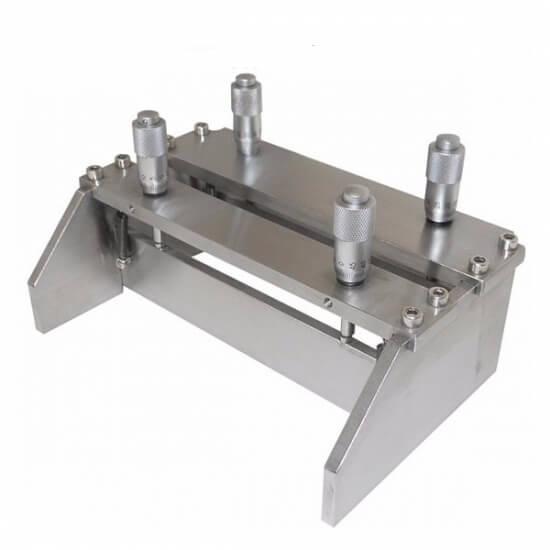
Film Applicator Coater
Applications of Bar Coaters
Bar coaters are used in a wide range of industries that require thin and uniform coatings. In lithium-ion battery research and production, they are widely adopted for coating electrode materials including cathode slurries (e.g., NCM, LFP) and anode slurries (e.g., graphite, silicon-carbon composites). Precise control of the coating thickness is critical for optimizing energy density, rate performance, and cycle life.
In the electronics and semiconductor industry, bar coaters apply insulating films, conductive inks, and photoresist coatings for functional material development and prototyping.
In material science laboratories, researchers rely on bar coaters for preparing polymer films, hydrogels, ceramic coatings, and nanomaterial layers for experimental studies. Packaging, printing, and adhesive industries also utilize bar coaters for controlled application of glues, lacquers, and surface treatments.
Advantages of Using a Bar Coater
One of the primary advantages of a bar coater is its simplicity and cost-effectiveness, making it ideal for both small-scale experiments and large-scale production. It requires minimal maintenance and offers long service life, especially when constructed from high-quality stainless steel.
Another key benefit is high coating reproducibility, which is essential for scientific experiments, quality control, and preliminary material screening. By using wires of specific diameters, users can easily adjust coating thickness without modifying machine settings.
The bar coater also supports broad material compatibility, enabling rapid switching between different coating formulations without extensive cleaning or setup procedures.
Finally, its ability to produce consistent, uniform coatings enhances product performance in applications where even slight thickness deviations can impact conductivity, adhesion, optical clarity, or mechanical strength.


 Online service
