Lith Corporation, founded in 1998 by a group of material science doctor from Tsinghua University, has now become the leading manufacturer of battery lab&production equipment. Lith Corporation have production factories in shenzhen and xiamen of China.This allows for the possibility of providing high quality and low-cost precision machines for lab&production equipment,including: roller press, film coater,mixer, high-temperature furnace, glove box,and complete set of equipment for research of rechargeable battery materials. Simple to operate, low cost and commitment to our customers is our priority.
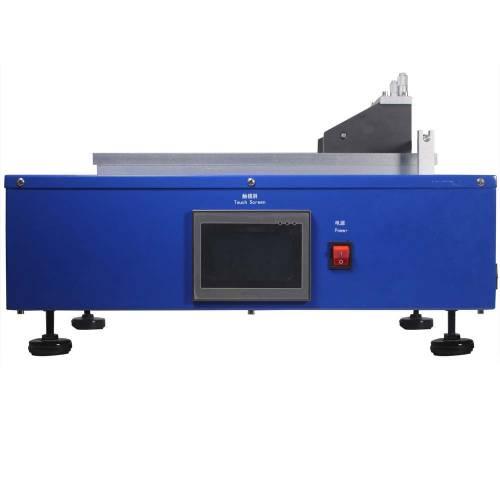
The automatic film applicator is a precision instrument widely used in laboratories and industrial environments for producing uniform, repeatable thin films and coatings on a variety of substrates. As material research, battery development, surface engineering, and quality-control standards continue to advance, the demand for consistent coating accuracy becomes more critical. The automatic film applicator addresses these needs by delivering controlled coating parameters, high reproducibility, and compatibility with different coating materials, making it an essential tool for research institutes, production labs, and manufacturing quality-control departments.
Overview
An automatic film applicator is designed to apply liquid or slurry materials—such as electrode slurries, paints, adhesives, inks, polymers, or nanomaterial dispersions—onto flat substrates in a highly controlled manner. Unlike manual coating, which often suffers from uneven thickness and operator variability, an automatic film applicator standardizes the coating process through programmable speed, pressure, draw-down length, and coating gap. This ensures that each film produced meets precise thickness, uniformity, and surface-quality requirements.
The device typically consists of a stable coating platform, a motor-driven coating head, and adjustable application bars or doctor blades. Many modern systems also incorporate digital controllers, vacuum-suction plates, heating platforms, and software interfaces to achieve superior consistency and advanced process control.
Key Features
1. Precise Film Thickness Control The automatic film applicator allows precise adjustment of coating thickness through micrometer-controlled blades or bar coaters. This ensures highly consistent results between batches, which is especially critical in battery slurry coating, optical films, and functional coatings.
2. Programmable Coating Parameters Speed, stroke length, and coating pressure can be precisely programmed. The controlled movement of the coating head eliminates variations caused by manual handling.
3. Stable and Uniform Coating Platform Many units include a vacuum-suction plate to hold substrates firmly in place. This prevents substrate shifting and ensures smooth, uniform film surfaces.
4. Compatibility with Multiple Coating Tools The system supports various applicators, including stainless-steel doctor blades, adjustable micrometer heads, and wire-wound bar coaters. This versatility allows users to perform different coating experiments with one instrument.
5. Optional Heating Functions Some systems offer integrated heating stages, enabling simultaneous coating and drying—ideal for battery electrode slurry, polymer solutions, UV-curable resins, and solvent-based coatings.
6. Digital Feedback and Repeatability Digital controllers ensure high repeatability. Once a coating program is saved, identical films can be reproduced consistently.
Manufacturing Process and Operation
Using an automatic film applicator generally follows a straightforward yet controlled process:
1. Substrate Preparation The substrate—such as aluminum foil, glass, PET film, or stainless steel—is cleaned and secured onto the coating bed. Vacuum suction may be activated if available.
2. Coating Tool Selection Users choose the appropriate application tool depending on the required thickness and coating type. Micrometer blades are preferred for battery slurry or thick coatings, while wire bar coaters suit thin and precise film layers.
3. Slurry or Solution Loading The coating material is deposited at the starting edge of the substrate. Its viscosity and formulation determine the ideal coating speed.
4. Parameter Programming The user sets stroke speed, stroke length, coating gap, and optional heating parameters through the digital interface.
5. Automatic Coating Process The applicator head moves across the substrate smoothly, forming a uniform film. Real-time speed control ensures consistent coating thickness independent of operator skill.
6. Drying or Curing When a heating platform is included, solvent evaporation or partial curing begins immediately. For advanced coatings, further drying or curing may occur in ovens or environmental chambers.
The automatic film applicator serves a wide range of industries:
* Lithium-ion battery research and production (electrode slurry coating on Al/Cu foil) * Paints and coatings evaluation (viscosity, color, coating strength, and surface finish tests) * Material science and nanotechnology (polymer films, conductive layers, ceramic slurries) * Adhesive and resin formulations * Optical and electronic films * Ink and printing research
Its ability to deliver highly reproducible films makes it indispensable for R&D laboratories seeking stable coating parameters for performance comparison.
Advantages
1. High Reproducibility Minimizes operator influence, ensuring every coating meets identical standards.
3. Efficient and Time-Saving Automated processes significantly reduce manual labor and experiment time.
4. Versatile Coating Capability Supports a wide range of materials from low-viscosity inks to high-viscosity battery slurries.
5. Enhanced Experimental Accuracy Useful for quality evaluations, material formulation optimization, and industrial standard testing.
Conclusion
The automatic film applicator is a critical instrument for modern research and production environments that demand high-quality, consistent coating results. With precise control, excellent repeatability, and broad material compatibility, it ensures reliable film preparation for battery manufacturing, material science, coating development, and industrial quality testing. As industries continue to push for higher performance and more consistent processes, the automatic film applicator remains an essential tool for achieving uniform, reproducible, and high-precision thin-film coatings.


 Online service
