Lith Corporation, founded in 1998 by a group of material science doctor from Tsinghua University, has now become the leading manufacturer of battery lab&production equipment. Lith Corporation have production factories in shenzhen and xiamen of China.This allows for the possibility of providing high quality and low-cost precision machines for lab&production equipment,including: roller press, film coater,mixer, high-temperature furnace, glove box,and complete set of equipment for research of rechargeable battery materials. Simple to operate, low cost and commitment to our customers is our priority.
Film Applicator Price: Overview, Features, Process, Applications, Advantages, and Conclusion
The term film applicator price is frequently discussed in research laboratories, production facilities, and quality-control departments when selecting equipment for precision coating work. A film applicator is a device used to produce uniform, reproducible thin films of paints, slurries, pastes, or functional materials on various substrates such as metal foils, glass plates, polymer films, and ceramic tapes. Understanding the relationship between performance and film applicator price helps users choose the right tool for both technical requirements and budget considerations.
Overview
A film applicator is essential for industries that rely on accurate film thickness, such as battery manufacturing, coatings development, printing, electronic materials, and academic research. Prices can vary widely depending on design, material, adjustability, and whether the applicator is manual, semi-automatic, or fully automated. While simple manual applicators have low prices, advanced automated applicators command higher costs but offer significantly greater precision and repeatability.
Key Features Influencing Film Applicator Price
Several features directly influence the film applicator price, and they also determine the device's performance level:
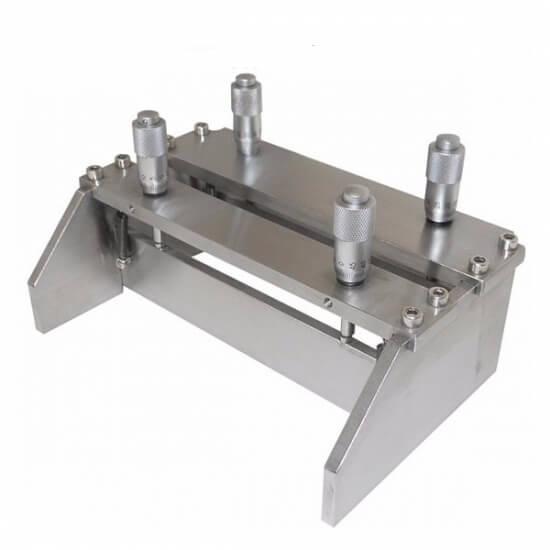
* Adjustable Film Thickness: Applicators with micrometer-adjustable gaps generally cost more but offer superior control.
* Material and Build Quality: Stainless steel, ceramic blades, and corrosion-resistant components increase durability and price.
* Coating Width and Substrate Compatibility: Larger coating widths and support for various substrate types add to the value.
* Manual vs. Automatic Operation: Motorized systems with programmable speed and heating functions typically have higher prices.
* Precision and Repeatability: High-accuracy mechanisms reduce variation in film thickness, often resulting in a higher cost.
* Optional Features: Components such as heated vacuum plates, digital displays, and intelligent speed control also influence price.
Coating Process Using a Film Applicator
Regardless of the film applicator price, the coating process generally follows a similar sequence:
1. Substrate Preparation: The substrate is cleaned, dried, and secured to avoid defects.
2. Blade or Applicator Setup: Gap height or blade selection is adjusted based on the desired wet-film thickness.
3. Material Application: A measured amount of coating slurry or liquid is placed on the substrate.
4. Controlled Coating Motion: The applicator travels across the substrate manually or via motorized drive to form an even film.
5. Drying or Curing: The wet film is allowed to dry naturally or using heating systems to achieve a stable, uniform coating.
6. Inspection and Testing: Surface uniformity, thickness, and adhesion are evaluated for quality control.
Higher-priced applicators tend to excel in stability, consistency, and precision during these steps.
Film Coating Machine
Applications
Film applicators, regardless of their price range, are used across multiple scientific and industrial fields:
* Battery Electrode Manufacturing: Coating slurries for cathodes and anodes in lithium-ion and sodium-ion batteries.
* Ceramic Tape Casting: Producing uniform ceramic layers for fuel cells, sensors, and electronic components.
* Paint and Coating Development: Creating consistent samples for R&D, color matching, and quality testing.
* Printed Electronics: Applying conductive and functional inks for flexible circuits and solar cells.
* Material Research: Studying new polymer, composite, and nano-material formulations through controlled coating tests.
The choice of film applicator price level depends on coating accuracy requirements and production scale.
Advantages
Regardless of price, film applicators offer several important advantages:
* High Uniformity: Ensures smooth, defect-free coatings essential for research and manufacturing.
* Precise Thickness Control: Adjustable systems allow accurate tuning of wet-film thickness.
* Material Efficiency: Reduces waste by providing controlled, repeatable coating processes.
* Versatility: Supports a wide variety of materials, viscosities, and substrates.
* Scalability: Laboratory tests can be correlated with pilot and industrial coating processes.
* Reliable Performance: High-quality applicators offer long service life and consistent results.
Higher-end applicators enhance these advantages by offering automation, digital control, and advanced stability.
Conclusion
In conclusion, understanding the film applicator price is essential when selecting equipment for precision coating applications. While low-cost manual applicators are suitable for basic laboratory use, mid-range adjustable models and high-end automated film applicators provide superior accuracy, efficiency, and repeatability. The proper balance between performance and price depends on the specific application—whether in battery research, material development, flexible electronics, or paint formulation. Ultimately, a well-chosen film applicator ensures reliable, consistent coatings and supports high-quality research and production outcomes.


 Online service
