Lith Corporation, founded in 1998 by a group of material science doctor from Tsinghua University, has now become the leading manufacturer of battery lab&production equipment. Lith Corporation have production factories in shenzhen and xiamen of China.This allows for the possibility of providing high quality and low-cost precision machines for lab&production equipment,including: roller press, film coater,mixer, high-temperature furnace, glove box,and complete set of equipment for research of rechargeable battery materials. Simple to operate, low cost and commitment to our customers is our priority.
Film Applicator – Professional Mechanical Equipment Introduction
A film applicator is a precision coating device designed to deposit uniform, reproducible thin films of liquids, slurries, pastes, or polymer solutions onto flat substrates. It plays a critical role in quality control, material development, battery research, paint formulation, adhesive testing, and surfacecoating engineering. By ensuring consistent wetfilm thickness and controlled spreading, the film applicator enables accurate evaluation of coating performance and material behavior. With advancements in coating technology, modern film applicators offer high precision, adjustable parameters, and compatibility with multiple materials and substrates.
1. Concept of the Film Applicator
A film applicator operates by spreading a coating material across a substrate using a defined gap or controlled geometry. The applicator ensures that the liquid or slurry forms a film of consistent thickness, width, and surface quality. The uniformity of the wet film is essential for subsequent processes such as drying, curing, thermal treatment, or functional testing. Film applicators are widely used in laboratories and pilot lines to simulate industrial coating processes in a controlled and repeatable manner.
Depending on design, film applicators may be manual, semiautomatic, or fully automatic, and they support applications ranging from micrometerlevel coatings to thicker functional layers for batteries and composites.
2. Structural Design
A film applicator generally consists of several key structural components:
• Coating Head or Applicator Bar
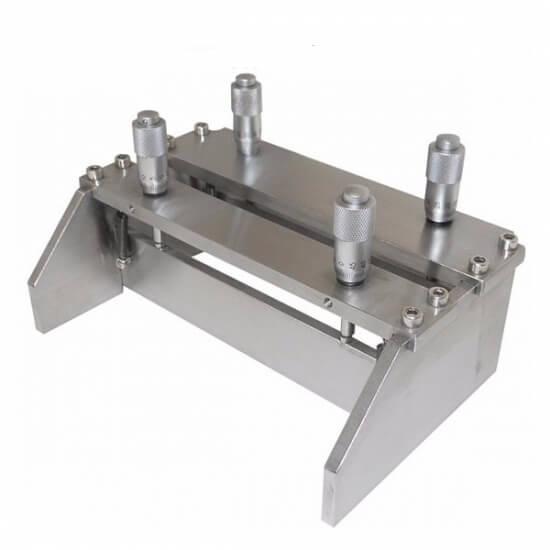
This is the core element responsible for controlling coating thickness. Common designs include blade applicators, wirewound rods, adjustablegap bars, and precision slot heads.
• Coating Platform
A stable, flat, and rigid base—often made of glass, stainless steel, or vacuumsuction plates—to hold substrates firmly during coating.
• Gap Adjustment Mechanism
For adjustablegap applicators, micrometer screws or digital actuators are used to set the coating thickness with micrometerlevel accuracy.
• Drive System (in automatic models)
A motorized linear drive controls the coating speed, stroke length, and acceleration, ensuring consistency across multiple coating cycles.
• Control Interface
Digital display, PLC controller, or touch panel for setting parameters such as coating speed, pressure, and travel distance.
• Optional Heating or Vacuum Modules
Some models include temperaturecontrolled platforms or vacuum beds to secure delicate substrates and support temperaturesensitive coatings.
3. Key Characteristics
• High Precision Thickness Control
Film thickness can be controlled within ±1–5 µm depending on the applicator design and coating conditions.
• Wide Material Compatibility
Suitable for viscous slurries, lowviscosity liquids, inks, binders, adhesives, ceramic slurries, polymer solutions, and electrode pastes.
• Smooth and Consistent Film Surface
Uniformity is ensured through stable coating geometry and steady coating speed.
• Flexible Configurations
Available in manual bars, adjustable doctor blades, wire rods, and programmable automatic coaters to meet diverse coating needs.
• Stable and Repeatable Operation
Automatic models eliminate human variability, supporting highprecision research and production processes.
4. Process Technology
The coating process conducted with a film applicator typically includes the following steps:
• Material Preparation
Mixing, filtering, and adjusting viscosity to ensure stable flow behavior during coating.
• Substrate Preparation
Cleaning, drying, or pretreating the substrate to ensure adhesion and uniform wetting.
• Setting Coating Parameters
Adjusting blade gap, coating speed, pressure, and travel distance based on target film thickness.
The applicator bar moves across the surface, spreading material and forming a controlledthickness wet film.
• Drying or Curing
The coated film undergoes thermal drying, UV curing, or solvent evaporation to achieve its final properties.
This process simulates industrial techniques such as slotdie coating, rolltoroll coating, or doctorblade spreading, enabling laboratoryscale formulation optimization.
5. Applications
Film applicators are widely used across many industries and research fields:
• Battery Electrode Manufacturing
Coating cathode and anode slurries onto current collectors for lithiumion or sodiumion batteries.
• Paints, Coatings, and Inks
Testing color uniformity, gloss, drying behavior, and adhesion properties.
• Adhesives and Sealants
Evaluating curing performance, viscosity, and bonding characteristics.
• Polymer and Composite Materials
Forming thin films for material testing, optical evaluation, or barrierproperty measurement.
• Electronics and Functional Materials
Applying conductive inks, dielectric pastes, and nanomaterials onto substrates.
• Research and Education
Used in labs for formulation development, quality control, and process optimization.
6. Advantages
• Excellent Coating Uniformity
Ensures reproducible film thickness and high surface quality for precise evaluation.
• High Efficiency and Repeatability
Automatic applicators provide stable coating results across multiple samples.
• Versatile Configurations
Supports various materials, thickness ranges, and substrate types.
• Reduced Material Waste
Precise gap control minimizes excess slurry usage and improves experiment efficiency.
• Scalable for Industrial Production
Laboratory results can be directly transferred to pilotscale and industrial coating systems.
• Enhanced Experimental Control
Adjustable parameters allow researchers to systematically study material behavior under controlled coating conditions.
Conclusion
The film applicator is a vital tool in modern coating technology, offering precise control over film thickness, material distribution, and coating uniformity. Its robust structural design, versatile coating capabilities, and ability to handle diverse materials make it indispensable in battery research, material sciences, coating formulation, and industrial quality control. Whether used for scientific experimentation or preproduction testing, the film applicator ensures repeatable, accurate, and highquality coating results essential for advanced manufacturing and research applications.


 Online service
