Lith Corporation, founded in 1998 by a group of material science doctor from Tsinghua University, has now become the leading manufacturer of battery lab&production equipment. Lith Corporation have production factories in shenzhen and xiamen of China.This allows for the possibility of providing high quality and low-cost precision machines for lab&production equipment,including: roller press, film coater,mixer, high-temperature furnace, glove box,and complete set of equipment for research of rechargeable battery materials. Simple to operate, low cost and commitment to our customers is our priority.
Doctor Blade Coating – Professional Mechanical Equipment Introduction
Doctor blade coating is a widely used filmforming and surfacecoating technique applied in battery manufacturing, functional materials, thinfilm electronics, ceramics, adhesives, and various industrial processes. The system employs a precision blade—known as a doctor blade—to control the thickness and uniformity of slurry, paste, or liquid materials spread onto a substrate. With advantages in coating precision, consistency, and adaptability, doctor blade coating has become a standard method for producing highquality films required in advanced technologies such as lithiumion batteries, sodiumion batteries, fuel cells, capacitors, and optical devices.
1. Concept of Doctor Blade Coating
Doctor blade coating, also known as knife coating or slotblade coating, is a method in which a liquid material is applied to a moving substrate and excess material is removed or shaped by a blade set at a precise gap height. The blade regulates the wetfilm thickness, ensuring consistent deposition across the substrate surface. By adjusting parameters such as blade height, slurry viscosity, substrate speed, and coating pressure, the system can produce uniform films ranging from a few micrometers to several hundred micrometers in thickness.
This technique is especially suitable for highviscosity slurries containing solid particles, such as electrode pastes in battery production and ceramic suspensions in advanced materials processing.
2. Structural Design
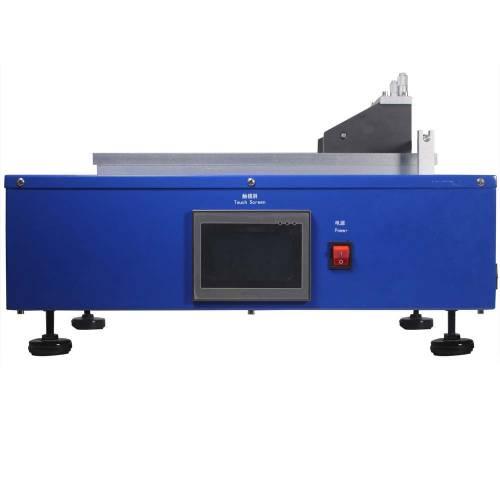
A typical doctor blade coating machine includes the following major components:
• Coating Head and Doctor Blade
The blade—made of stainless steel, tungsten carbide, ceramic, or polymer composites—forms the critical gap that determines the coating thickness. It can be fixed, adjustable, or pneumatically controlled.
• Substrate Transport System
A vacuumadsorption conveyor or filmtransport roller moves the substrate at a stable and controlled speed. This ensures uniform spreading and prevents defects such as streaking or air bubbles.
• Slurry Feeding System
Materials are delivered to the coating area through a reservoir, pump, or automatic feeding system. Flow stability is essential for maintaining consistent coating mass.
• PrecisionAdjustment Mechanism
Micrometers or motorized actuators allow precise adjustment of the blade gap, coating pressure, and blade angle.
• Drying or Curing Unit
Many systems integrate IR heating, hotair ovens, microwave drying, UV curing, or controlledtemperature chambers to remove solvent and solidify the film.
• Control and Monitoring System
Advanced systems include PLCs, touchscreen interfaces, speed controllers, thickness sensors, and realtime monitoring cameras.
3. Key Characteristics
• High Thickness Precision
Blade gap can be controlled within micrometer accuracy, enabling tight filmthickness tolerances.
• Strong Material Compatibility
The system can handle slurries of varying viscosity, particle size, and rheological behavior.
• Uniform Coating Quality
Consistent mechanical control and slurry distribution result in uniform films with minimal defects.
• Adjustable Coating Parameters
Blade height, substrate speed, tension, and slurry flow can be tailored for different materials and applications.
• Scalability
Doctor blade coating supports both smallscale laboratory experimentation and highvolume industrial production.
4. Process Technology
The doctor blade coating process typically involves several stages:
• Substrate Preparation
Cleaning, preheating, or surface treatment ensures strong adhesion and uniform spreading.
• Slurry Application
Material is supplied directly to the coating zone, forming a wet layer ahead of the blade.
• Thickness Control
The doctor blade removes excess liquid and shapes the film to the desired thickness.
• WetFilm Stabilization
The coated substrate passes through a leveling zone to eliminate ripples and improve uniformity.
• Drying or Curing
Solvent evaporation or chemical curing solidifies the coated layer, forming a stable thin film.
• Final Inspection
Thickness measurement, surface roughness evaluation, and defect detection ensure quality compliance.
Tape Casting Coater
5. Applications
Doctor blade coating is used extensively in:
• Battery Industry
Coating cathode and anode slurries for lithiumion, sodiumion, solidstate, and flow batteries.
• Ceramic and Functional Materials
Producing ceramic green tapes, dielectric films, and thermalbarrier coatings.
• Electronics and Optoelectronics
Fabricating display films, conductive layers, polymer solar cells, and flexible circuits.
• Adhesives and Protective Coatings
Applying glue, resin, polymer films, and moistureresistant coatings.
• Scientific Research
Used in R&D labs for process optimization and materialproperty research.
6. Advantages
• Excellent Film Uniformity
Provides stable thickness control and low variation across large substrate areas.
• High Production Efficiency
Continuous operation supports mass production with consistent quality.
• Flexible Material Processing
Suitable for a wide range of viscosities, particleladen slurries, and specialty formulations.
• Low Operation Cost
Simple mechanical structure reduces maintenance and energy consumption.
• Easy ScaleUp
Laboratoryscale coaters can transition to industrial production with minimal process changes.
• High Repeatability
Fine mechanical adjustments ensure reproducible filmforming results across production batches.
Conclusion
The doctor blade coating technique is a mature, versatile, and highly reliable filmforming method for industrial and research applications. Its precise thickness control, wide material compatibility, and efficient continuous operation make it indispensable in battery manufacturing, advanced ceramics, thinfilm electronics, and functional material production. With its balance of precision, scalability, and costeffectiveness, doctor blade coating continues to play a crucial role in enabling highperformance materials and nextgeneration technologies.


 Online service
