Lith Corporation, founded in 1998 by a group of material science doctor from Tsinghua University, has now become the leading manufacturer of battery lab&production equipment. Lith Corporation have production factories in shenzhen and xiamen of China.This allows for the possibility of providing high quality and low-cost precision machines for lab&production equipment,including: roller press, film coater,mixer, high-temperature furnace, glove box,and complete set of equipment for research of rechargeable battery materials. Simple to operate, low cost and commitment to our customers is our priority.
Introduction to Dr Blade Coating Equipment: Overview, Features, Process, Applications, and Advantages
The dr blade coating technique—also known as doctor blade coating—is a highly versatile and widely adopted method for producing uniform films and coatings across a variety of industrial sectors. As modern material science increasingly demands precision-controlled film thickness, high consistency, and scalable fabrication, dr blade coating equipment has become an essential tool for laboratories and manufacturing plants. This technology is especially valued in industries such as battery electrode production, functional materials R&D, ceramics, electronics, and membrane engineering. The following sections provide a comprehensive overview of the equipment structure, technical characteristics, operational process, application fields, and key advantages.
Overview of Dr Blade Coating Equipment
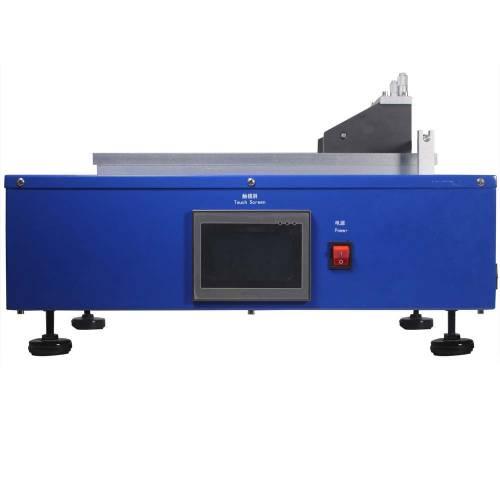
Dr blade coating equipment is designed to apply a consistent liquid slurry or paste onto a substrate by using a fixed-gap blade (doctor blade). The equipment controls the blade height, speed, and coating pressure to achieve highly uniform thickness. The system typically consists of a coating platform, an adjustable blade assembly, a controlled feeding mechanism, a precision motion stage, and an integrated heating or drying module. This technology allows for continuous or batch coating, making it suitable both for laboratory research and pilot-scale production.
The dr blade coating method is particularly effective for materials that require tight thickness tolerances, such as lithium-ion battery electrode slurries, ceramic suspensions, polymer films, and conductive pastes. Its compatibility with a wide range of viscosities further enhances its usability.
Key Features of the Equipment
1. Precision Thickness Control
One of the most important features of dr blade coating equipment is its ability to precisely regulate the blade gap. By adjusting the blade height with micrometer or servo control, users can achieve film thicknesses ranging from micrometers to several hundred micrometers with high reproducibility.
2. Stable Coating Speed and Motion
Advanced equipment utilizes linear guides and servo-driven stages to ensure uniform motion. Stable coating speed minimizes defects such as ribbing, streaks, or thickness fluctuations.
3. Compatibility with Various Substrates
Dr blade coating can be applied on aluminum foil, copper foil, PET film, glass, ceramic plates, and other substrates. This makes the system highly adaptable for different material research needs.
4. Modular Design for Laboratory and Scale-Up Use
Many machines feature modular heating beds, vacuum chuck tables, and adjustable blade geometries. These options allow scientists and engineers to tailor the system for different slurry behaviors and drying conditions.
5. User-Friendly Digital Controls
Modern dr blade coating equipment is equipped with touchscreen interfaces and programmable recipes, enabling precise repeatability and simplified operation.
Dr Blade Coating Process
The dr blade coating process involves several well defined steps:
1. Slurry Preparation
The coating slurry is mixed, dispersed, and degassed to achieve the desired viscosity and uniformity. The quality of the slurry is critical to achieving a defect-free coating.
2. Substrate Positioning
The substrate is fixed onto the coating platform, often using a vacuum chuck to ensure flatness and eliminate wrinkles during coating.
3. Blade Height and Speed Adjustment
The operator sets the coating thickness by adjusting the blade gap. The coating speed is selected based on slurry viscosity and desired film characteristics.
4. Coating Execution
The blade moves relative to the substrate (or vice versa), spreading the slurry into a uniform film. The controlled motion ensures smooth deposition.
5. Drying or Thermal Treatment
After coating, the wet film undergoes drying, baking, or UV curing depending on the material system. For battery applications, the coated electrodes may be further calendered or rolled to compress the structure.
This method ensures consistency and repeatability, factors essential for high-performance functional films.
DR Blade
Applications of Dr Blade Coating Technology
1. Lithium-Ion Battery Electrode Fabrication
The dr blade method is widely used to coat cathode and anode slurries on metal foils with controlled thickness and uniform active material distribution.
2. Ceramic and Functional Films
Ceramic tapes, dielectric layers, and advanced oxide films can be fabricated using this technique due to its excellent thickness uniformity.
3. Conductive and Polymer Films
Conductive coatings, polymer electrolytes, and sensor materials benefit from the technology’s adaptability to different viscosities.
4. Membrane and Filter Fabrication
The process is commonly used in manufacturing porous membranes, separation films, and filtration materials.
5. Optoelectronic and Photovoltaic Materials
Quantum dot films, perovskite layers, and organic semiconductor coatings are often produced through dr blade coating for research and prototype development.
Advantages of Dr Blade Coating Equipment
1. High Uniformity and Precision
The ability to control thickness with micrometer accuracy ensures consistent performance of coated films.
2. Wide Material Compatibility
Equipment can handle slurries of varying viscosity and particle size, making it ideal for R&D across many material classes.
3. Cost-Effective and Scalable
The method is simpler and more economical than vacuum-based deposition, and it can easily scale from lab tests to pilot production.
4. Strong Repeatability
Digital control systems guarantee consistent coating results, which is crucial for scientific studies and quality-controlled manufacturing.
5. Easy Operation and Maintenance
The modular design and intuitive control interface reduce training time and allow for quick adjustments.


 Online service
