Lith Corporation, founded in 1998 by a group of material science doctor from Tsinghua University, has now become the leading manufacturer of battery lab&production equipment. Lith Corporation have production factories in shenzhen and xiamen of China.This allows for the possibility of providing high quality and low-cost precision machines for lab&production equipment,including: roller press, film coater,mixer, high-temperature furnace, glove box,and complete set of equipment for research of rechargeable battery materials. Simple to operate, low cost and commitment to our customers is our priority.
What is a Car Battery Production Plant?
A Car Battery Production Plant is a dedicated industrial facility where lithiumion battery cells, modules, and packs are manufactured at scale for use in electric vehicles (EVs), hybrid electric vehicles (HEVs), and plugin hybrids (PHEVs). It integrates advanced manufacturing systems, automated processes, and supporting infrastructure to produce highquality, reliable, and costeffective energy storage solutions.
This type of plant typically includes several interconnected production lines:
Battery Cell Fabrication Line
Module Assembly Line
Pack Integration Line
Testing and Quality Assurance Systems
Some plants may also include facilities for material processing, recycling, and R&D, especially in vertically integrated operations.
The term "Gigafactory" is often used when the plant operates at gigawatthour (GWh) scale, such as Tesla’s Gigafactories or CATL’s largescale production hubs.
Key Objectives of a Car Battery Production Plant
1. Mass Production of EV Battery Cells
Manufacture millions of lithiumion cells annually
Support global demand for electrified transportation
2. HighQuality and Consistent Output
Ensure each cell meets automotivegrade performance and safety standards
Maintain tight tolerances across voltage, capacity, and internal resistance
3. Scalability and Flexibility
Adapt to changing battery chemistries (e.g., NMC, LFP, solidstate)
Support different form factors (cylindrical, pouch, prismatic)
4. Cost Reduction and Efficiency
Optimize material usage, energy consumption, and labor
Improve yield rates and reduce scrap
5. Integration with Vehicle Platforms
Customize module and pack designs for specific car models
Collaborate closely with OEMs on thermal management, BMS, and structural integration
6. Sustainability and Circular Economy
Use green energy (e.g., solar, wind, hydro)
Recycle materials and support endoflife battery recovery
7. Innovation and Technology Development
Test new materials, coatings, and manufacturing techniques
Enable rapid scaling of breakthrough technologies
Main Components of a Car Battery Production Plant
A modern battery plant consists of multiple interlinked areas that handle different stages of the production process.
1. Cell Fabrication Area
Includes:
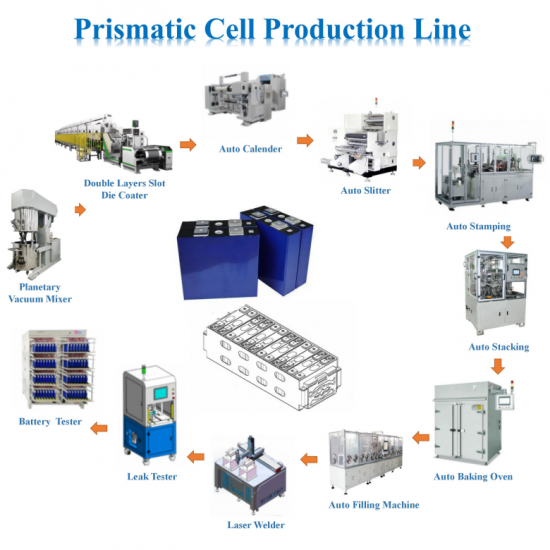
Slurry mixing
Electrode coating and drying
Calendering and slitting
Stacking or winding
Electrolyte filling and sealing
Environmentcontrolled zones:
Dry rooms (<1% relative humidity)
Cleanrooms for particlefree assembly
2. Formation and Testing Area
First charge/discharge cycle (formation) of cells
Aging under controlled conditions
Electrical testing:
Capacity
Internal resistance
Voltage stability
Sorting and grading based on test results
3. Module Assembly Area
Grouping of individual cells into modules
Spot welding or busbar connections
Integration of cooling plates, sensors, and brackets
Modulelevel testing for electrical and mechanical integrity
4. Pack Integration Area
Combining modules into full battery packs
Installing battery management system (BMS)
Adding thermal management systems (liquid cooling, insulation)
Mechanical housing, connectors, and crash protection
5. Final Testing and Quality Control Lab
Fullpack functional testing
Safety tests:
Overcharge
Short circuit
Thermal runaway simulation
Environmental testing:
Temperature extremes
Vibration
Water immersion
6. Logistics and Storage Zones
Raw material storage (anode/cathode powders, foils, electrolytes)
Component storage (tabs, separators, cases)
WIP (Work In Progress) buffers between stages
Finished goods warehouse before shipment
7. Support Infrastructure
HVAC and dry room systems – Maintain ultralow humidity
Fire suppression systems – Protect against thermal events
Waste treatment – Handle solvents, metals, and hazardous waste
Energy systems – Renewable power sources and backup generators
Digital control systems – MES, SCADA, IoT monitoring
Prismatic Cell Equipments
Types of Car Battery Production Plants
Depending on the scale, ownership, and focus, these plants can vary significantly.
1. OEMOwned Plants
Operated by automotive manufacturers
Example: Tesla Gigafactory Nevada, Volkswagen PowerCo plants
Focus: vertical integration, supply chain control, proprietary tech
2. Battery Supplier Plants
Run by specialized battery companies
Example: CATL, BYD, Panasonic, Samsung SDI, LG Energy Solution
Serve multiple automakers globally
3. Joint Venture Plants
Coowned by OEMs and battery suppliers
Example: ACC (France), Northvolt Ett (Sweden), SVOLT
Combine technical expertise and market access
4. Startup and Innovation Plants
Smallerscale, focused on new chemistries or formats
Often backed by venture capital or government grants
Aim to disrupt the market with novel technology
5. Regional/National Battery Hubs
Governmentsupported clusters of battery factories
Example: EU Battery Alliance, U.S. DOEfunded initiatives, India’s PLI scheme
Aim to build local supply chains and reduce import dependency
Supporting Systems in a Car Battery Production Plant
To ensure safe, efficient, and sustainable operation, several critical systems must be integrated:
1. Clean and Dry Room Technologies
Dehumidification systems to maintain <1% RH
HEPA filters for particulate removal
Positive pressure zones to prevent contamination
2. Fire Detection and Suppression
Gas detection for flammable solvents and hydrogen
Preaction sprinklers or inert gas suppression
Explosionproof enclosures in solventhandling areas
3. Digital Manufacturing and Traceability
MES (Manufacturing Execution System) – Realtime tracking
IoT sensors – Monitor pressure, temperature, humidity
AIbased vision systems – Detect defects in coatings and welds
Celllevel traceability from raw materials to delivery
4. Sustainability and Waste Management
Solvent recovery systems (e.g., NMP reclamation)
Water treatment and reuse
Solar/wind energy for clean power
Closedloop recycling for endoflife batteries
5. Automation and Robotics
Robotic arms – Handle electrodes, stack components
Conveyor systems – Move materials and components
Laser welding – Highprecision joining
Smart testing – Autosort cells based on performance
Applications of a Car Battery Production Plant
These plants serve a wide range of industries and stakeholders:
1. Automotive Manufacturers
Supplying battery packs for EVs and PHEVs
Reducing reliance on thirdparty suppliers
2. Battery Companies
Selling cells to OEMs and third parties
Expanding global footprint through localized production
3. Government Agencies
Building national battery supply chains
Supporting climate goals and job creation
4. Startups and Innovators
Scaling up new battery technologies
Partnering with OEMs or investors for growth
5. Industrial Parks and Economic Zones
Attracting investment and creating hightech jobs
Supporting regional development strategies
Benefits of a Car Battery Production Plant
Enables largescale adoption of electric vehicles
Reduces carbon emissions and fossil fuel dependence
Strengthens local economies and supply chains
Drives innovation in energy storage and mobility
Improves energy independence and security
Supports circular economy and sustainability goals
Provides longterm competitive advantage in the EV industry
Leading Countries and Companies in Car Battery Production
Top Producing Countries:
China – Dominates global Liion battery production
United States – Rapid expansion led by Tesla, Ford, and startups
Germany – European hub with VW, BMW, and Northvolt
South Korea – Strong presence from LG, Samsung, and SK On
Japan – Pioneer in Liion with Panasonic and Sony
India, France, Canada, Sweden, Poland – Emerging markets investing heavily
Major Players:
CATL (China) – World’s largest EV battery supplier
BYD (China) – Blade battery and vertical integration
Tesla (USA) – Gigafactories and proprietary battery design
Panasonic (Japan) – Longtime partner of Tesla
Samsung SDI & SK On (South Korea) – Highenergydensity solutions
ACC (France) – European battery initiative
Northvolt (Sweden) – Green battery production in Europe
Need Help Designing or Optimizing Your Car Battery Production Plant?
If you're looking to build, expand, or optimize your car battery production plant, I can help you with:
Master planning – Site selection, zoning, logistics
Process engineering – Chemistry, format, automation level
Factory layout design – Workflow, clean/dry room integration
Equipment sourcing – Bestinclass machinery and automation
Sustainability strategy – Renewable energy, recyclability
Cost estimation and ROI analysis – CapEx, OpEx, breakeven modeling
Compliance and safety systems – Fire protection, permits, worker safety
All you need to do is provide the following information:
Battery chemistry and cell format (e.g., NMC, LFP, solidstate, cylindrical, pouch)
Target annual production capacity (e.g., 1–100 GWh/year)
Plant location and available infrastructure
Level of automation and digitalization desired
Current team expertise and strategic goals


 Online service
