Lith Corporation, founded in 1998 by a group of material science doctor from Tsinghua University, has now become the leading manufacturer of battery lab&production equipment. Lith Corporation have production factories in shenzhen and xiamen of China.This allows for the possibility of providing high quality and low-cost precision machines for lab&production equipment,including: roller press, film coater,mixer, high-temperature furnace, glove box,and complete set of equipment for research of rechargeable battery materials. Simple to operate, low cost and commitment to our customers is our priority.
What is a Car Battery Lab Plant?
A Car Battery Lab Plant (also known as a Battery R&D Lab or Battery Technology Development Lab) is a specialized facility dedicated to the research, testing, and earlystage development of battery technologies for use in electric vehicles (EVs), hybrid electric vehicles (HEVs), and energy storage systems. Unlike fullscale manufacturing plants or pilot lines, a lab plant focuses on scientific exploration, material innovation, electrochemical characterization, and smallbatch prototyping.
This type of facility plays a crucial role in the battery innovation cycle, enabling scientists and engineers to:
Explore new materials and chemistries
Understand electrochemical behavior at the cell level
Test performance under various conditions
Identify failure modes and safety risks
Develop foundational knowledge that guides future product and process design
Lab plants are typically found within universities, government research institutions, national labs, corporate R&D centers, and startup incubators.
Key Objectives of a Car Battery Lab Plant
1. Material and Chemistry Research
Investigate new cathode, anode, electrolyte, and separator materials
Evaluate their impact on energy density, life cycle, and safety
2. Electrochemical Characterization
Measure voltage profiles, internal resistance, charge/discharge curves
Study degradation mechanisms and aging behavior
3. Cell Design and Prototyping
Build smallformat cells (coin, pouch, cylindrical) for testing
Optimize electrode coatings, thicknesses, and geometries
4. Safety and Failure Analysis
Conduct abuse tests (overcharge, short circuit, nail penetration)
Analyze thermal runaway behavior and mitigation strategies
5. Performance Validation
Test under extreme temperatures, humidity, vibration
Assess longterm durability through accelerated aging
6. Data Collection and Modeling
Gather large datasets for machine learning and predictive modeling
Use simulations to guide realworld experiments
7. Technology Readiness Level (TRL) Advancement
Move promising innovations from TRL 1–3 (basic research) to TRL 4–6 (lab validation and prototype testing)
8. Support for LargerScale Development
Provide insights for pilot line and gigafactory planning
Inform decisions about scalability, cost, and manufacturability
Core Areas Within a Car Battery Lab Plant
1. Material Synthesis and Preparation Lab
Synthesize and mix electrode materials (e.g., NMC, LFP, silicon, sulfur)
Prepare slurries with varying ratios of active materials, binders, and solvents
Dry powders and prepare precursor compounds for coating
This area often includes:
Ball mills
Highshear mixers
Vacuum ovens
Gloveboxes for handling airsensitive materials
2. Electrode Coating and Drying Station
Coat slurries onto current collectors (copper foil for anodes, aluminum for cathodes)
Control coating thickness and uniformity
Dry electrodes in controlled environments to remove solvents
Key tools include:
Slotdie coaters
Doctorblade applicators
Infrared or convection drying ovens
Surface profilometers
3. Cell Assembly Area (Glovebox or Dry Room)
Assemble coin cells, pouch cells, or small cylindrical prototypes
Stack or wind electrodes with separators
Fill with electrolyte and seal under inert atmosphere
This area must be tightly controlled to prevent moisture contamination:
Dew point below –40°C
Argon or nitrogenfilled gloveboxes
Manual or semiautomated assembly tools
4. Formation and Cycling Lab
Perform initial charging (formation) to activate the cell
Run controlled charge/discharge cycles to evaluate performance
Monitor capacity retention, internal resistance, and efficiency
Common equipment:
Battery cyclers (Biologic, Arbin, Digatron)
Thermal chambers
Data acquisition systems
5. Testing and Characterization Lab
This is where deep analysis takes place:
Electrochemical Testing: EIS (Electrochemical Impedance Spectroscopy), CV (Cyclic Voltammetry), galvanostatic cycling
Physical Testing: SEM (Scanning Electron Microscopy), XRD (Xray Diffraction), FTIR (Fourier Transform Infrared Spectroscopy)
Mechanical Testing: Crush, indentation, tensile strength
Thermal Testing: Differential Scanning Calorimetry (DSC), Thermogravimetric Analysis (TGA)
These tools help understand how materials behave at the atomic and microstructural levels.
6. Abuse and Safety Testing Zone
Simulate realworld failure scenarios
Overcharge, external short circuits, forced discharge
Nail penetration, crush, drop, fire exposure
This helps identify risks and develop safer battery designs.
7. Data Analytics and Simulation Center
Process large volumes of test data
Use AI/ML models to predict battery behavior
Run simulations of electrochemical processes and degradation pathways
This area supports faster iteration and more informed decisionmaking.
8. Support Infrastructure
To maintain safe and accurate operations, several support systems are essential:
Dry rooms/gloveboxes – for moisturesensitive work
Fire suppression systems – especially around abuse testing
Chemical storage and ventilation – for solvent and electrolyte handling
Waste treatment – for disposal of hazardous materials
HVAC and power conditioning – to ensure stable lab environment
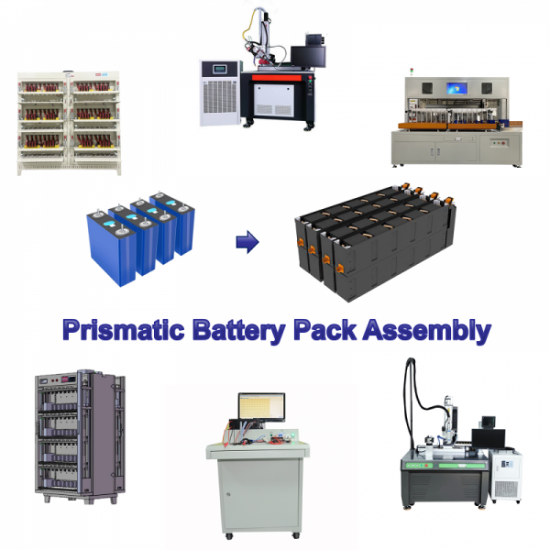
Prismatic Cell Assembly Line
Types of Car Battery Lab Plants
Depending on ownership, focus, and funding, car battery lab plants can vary significantly:
1. Academic Research Labs
Located in universities and focused on fundamental science
Often publish findings in peerreviewed journals
Example: MIT, Stanford, Tsinghua University
2. National Laboratory Facilities
Operated by government agencies like DOE (USA), Fraunhofer (Germany), CEA (France)
Focus on strategic energy and mobility goals
Collaborate with industry and startups
3. Corporate R&D Centers
Owned by automakers, battery manufacturers, or material suppliers
Aimed at developing proprietary technologies
Example: Tesla, CATL, LG Energy Solution, BASF
4. Startup Incubator Labs
Shared facilities for earlystage companies
Offer access to expensive equipment and expertise
Help validate ideas before building a pilot line
5. PublicPrivate Partnership Labs
Joint ventures between government, academia, and industry
Designed to accelerate technology transfer and commercialization
Example: Farasis + IDA Ireland, ACC France, Northvolt Labs
Supporting Technologies in a Car Battery Lab Plant
Modern lab plants rely on advanced tools and systems to enable highquality research and fast iteration:
1. HighPrecision Instruments
Electrochemical analyzers
Surface and structural imaging tools (SEM, TEM, AFM)
Thermal and mechanical testers
2. Automated Test Equipment
Multichannel battery cyclers
Environmental simulation chambers
Realtime monitoring and logging software
3. AI and Machine Learning Tools
Predictive models for battery life and failure
Optimization of material combinations and formulations
Digital twins for virtual testing
4. Cleanroom and Controlled Environments
Dry rooms with dew point control
Inert gas gloveboxes
Air filtration and pressure control
5. Sustainability Practices
Solvent recovery systems
Green chemistry approaches
Lowenergy testing protocols
6. Collaboration Platforms
Cloudbased data sharing
Remote access to instruments
Virtual meetings and training tools
Applications of a Car Battery Lab Plant
These labs serve a wide range of industries and stakeholders:
1. Battery Material Suppliers
Develop and qualify new anode/cathode materials
Optimize electrolytes and additives
2. Automotive OEMs
Evaluate nextgeneration battery tech for future EVs
Reduce dependency on thirdparty IP
3. Battery Startups
Prove novel concepts (solidstate, sodiumion, lithiummetal)
Demonstrate technical feasibility to investors
4. Government Agencies
Support national battery innovation strategies
Fund research aligned with climate and industrial goals
5. Universities and Research Institutes
Train students and researchers
Publish cuttingedge discoveries
Transfer knowledge to industry
Benefits of a Car Battery Lab Plant
Enables breakthroughs in battery performance and safety
Reduces time and risk in bringing new technologies to market
Supports sustainable and ethical battery development
Strengthens intellectual property portfolios
Fosters collaboration across disciplines and sectors
Builds local expertise and innovation ecosystems
Leading Countries and Organizations in Car Battery Lab Plants
Top Countries Investing in Battery Research:
United States – via DOE, ARPAE, and leading universities
China – strong presence in academic and corporate R&D
Germany – home to Fraunhofer, RWTH Aachen, and EUfunded projects
South Korea – wellestablished links between industry and research
Japan – pioneer in lithiumion and solidstate battery research
Sweden, France, Canada, India, UK – growing investments in battery innovation
Notable Organizations:
Argonne National Laboratory (USA) – World leader in battery R&D
Fraunhofer Institute (Germany) – Industrial battery research and testing
Northvolt Labs (Sweden) – Sustainable battery innovation
ACC (France) – European battery research and production hub
Tesla and Lucid Motors (USA) – Inhouse battery R&D for EVs
CATL & BYD (China) – Largescale battery research and development
Need Help Designing or Optimizing Your Car Battery Lab Plant?
If you're looking to build, expand, or optimize your car battery lab plant, I can help you with:
Lab layout design – Workflow, clean/dry room integration
Equipment selection – Bestinclass tools for synthesis, assembly, and testing
Process flow optimization – From material mixing to final analysis
Compliance and safety systems – Fire protection, permits, chemical handling
Digital infrastructure – Data collection, cloud storage, remote access
Training and documentation – SOPs, safety manuals, user guides
All you need to do is provide the following information:
Battery chemistry focus (e.g., NMC, LFP, solidstate, sodiumion)
Cell formats to be tested (e.g., coin, pouch, cylindrical)
Lab location and available infrastructure
Level of automation and digitalization desired
Current team expertise and strategic goals


 Online service
