Lith Corporation, founded in 1998 by a group of material science doctor from Tsinghua University, has now become the leading manufacturer of battery lab&production equipment. Lith Corporation have production factories in shenzhen and xiamen of China.This allows for the possibility of providing high quality and low-cost precision machines for lab&production equipment,including: roller press, film coater,mixer, high-temperature furnace, glove box,and complete set of equipment for research of rechargeable battery materials. Simple to operate, low cost and commitment to our customers is our priority.
What is a Car Battery Pilot Plant?
A Car Battery Pilot Plant is a smallscale, flexible manufacturing facility used to develop, test, and validate new battery technologies, chemistries, formats, and production processes before they are scaled up for mass production. Unlike fullscale gigafactories, pilot plants focus on research, innovation, and process optimization, serving as a critical bridge between laboratory research and industrial deployment.
These facilities allow companies, startups, and research institutions to:
Test new battery materials (e.g., cathodes, anodes, electrolytes)
Validate novel cell designs (e.g., cylindrical, pouch, prismatic, solidstate)
Optimize manufacturing workflows
Evaluate automation strategies
Ensure safety, performance, and costeffectiveness
Pilot plants are often integrated with R&D labs, testing centers, and prototyping workshops, enabling rapid iteration and datadriven decisionmaking.
Key Objectives of a Car Battery Pilot Plant
1. Technology Validation
Prove the feasibility of new battery chemistries and designs
Assess performance under realworld conditions
2. Process Development
Develop scalable and repeatable manufacturing methods
Identify bottlenecks and optimize yield rates
3. Cost Estimation
Understand material and labor costs at scale
Model capital expenditure (CapEx) and operating expense (OpEx)
4. Quality and Safety Testing
Conduct electrical, mechanical, and environmental testing
Ensure compliance with international standards (e.g., UN 38.3, IEC 62660)
5. Supporting ScaleUp Decisions
Provide data to justify investment in fullscale production
Help select optimal equipment, layout, and automation level
6. Training and Workforce Development
Train engineers and technicians on new systems
Build internal expertise before rampup
7. Partnership and Collaboration Hub
Enable collaboration between OEMs, suppliers, universities, and governments
Facilitate technology transfer and joint development agreements
Core Areas Within a Car Battery Pilot Plant
1. Material Preparation and Slurry Mixing Lab
Smallbatch mixing of electrode materials (anode/cathode slurries)
Testing different binders, solvents, and coating thicknesses
Emphasis on consistency and repeatability for earlystage validation
2. Electrode Coating and Drying Station
Precision coating of electrodes on metal foils (copper/aluminum)
Drying ovens to remove solvents
Thickness and uniformity checks using sensors and imaging tools
3. Cell Assembly Area
Stacking or winding of electrodes and separators
Insertion into casing (pouch, prismatic, or cylindrical)
Electrolyte filling and sealing under controlled environments
This area may include both manual and semiautomated workstations to simulate future production lines.
4. Formation and Aging Zone
Initial charging (formation) of cells to activate chemistry
Monitoring electrochemical behavior during early cycles
Data collection for performance prediction and grading
5. Testing and Characterization Lab
Comprehensive testing is central to a pilot plant’s mission:
Electrical: capacity, internal resistance, cycle life
Mechanical: crush, vibration, impact
Environmental: temperature extremes, humidity, altitude
Safety: overcharge, short circuit, nail penetration, thermal runaway
Test results guide design improvements and help identify failure modes.
6. Module and Pack Integration Prototyping Area
Assembling pilot cells into small modules and prototype packs
Integrating cooling plates, brackets, and BMS prototypes
Validating packlevel performance and thermal management strategies
This helps understand how individual cells behave in realworld configurations.
7. Data Analytics and Digital Twin Systems
Realtime monitoring of all processes and test results
Use of AI and machine learning to predict outcomes
Creation of digital twins for simulationbased process improvement
Digital tools accelerate learning and reduce trialanderror cycles.
8. Support Infrastructure
To ensure safe and efficient operation, several support systems are essential:
Clean/dry room HVAC – to protect sensitive processes from moisture
Fire suppression and gas detection – especially in solvent handling areas
Waste treatment and solvent recovery – for environmental compliance
Flexible layout design – allows reconfiguration for new processes
Types of Car Battery Pilot Plants
Depending on ownership, purpose, and funding, car battery pilot plants can vary significantly:
1. Corporate R&D Pilot Lines
Operated by automotive OEMs or battery manufacturers
Focused on proprietary technologies and vertical integration
Example: Tesla, CATL, BYD, Panasonic
2. Academic and Government Research Centers
Located within universities or national labs
Aimed at advancing fundamental battery science
Often supported by public funding
Example: Argonne National Lab (USA), Fraunhofer Institutes (Germany)
3. Startup Innovation Labs
Run by emerging battery tech companies
Used to prove concepts and attract investors
Often colocated with incubators or accelerators
4. PublicPrivate Partnership Facilities
Joint ventures between government, industry, and academia
Designed to build regional innovation ecosystems
Example: Farasis Energy + IDA Ireland, ACC France
5. Contract Manufacturing Pilot Plants
Thirdparty facilities offering pilot production services
Serve companies that lack inhouse capabilities
Offer flexibility and shared infrastructure
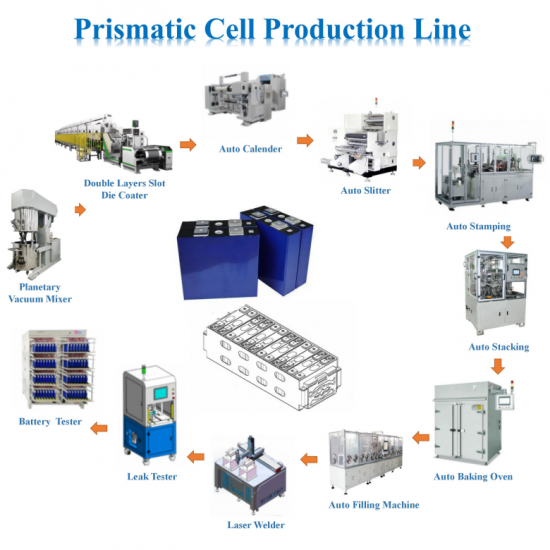
Prismatic Cell Equipments
Supporting Technologies in a Car Battery Pilot Plant
Modern pilot plants rely on advanced tools and systems to enable fast iteration and highquality output:
1. Flexible Automation Platforms
Modular machines that can be reconfigured for different chemistries or formats
Semiautomated workstations for quick prototyping
2. HighPrecision Sensors and Vision Systems
Realtime feedback on coating quality, alignment, and weld integrity
AIpowered defect detection and classification
3. Battery Simulation and Modeling Tools
Predictive modeling of battery behavior before physical testing
Helps guide formulation and design choices
4. MES and Process Monitoring Systems
Track every step of the manufacturing process
Maintain traceability from raw materials to final test data
5. Sustainability Features
Solvent recovery and reuse systems
Lowenergy drying and curing methods
Recyclable components and packaging
6. Collaboration and Remote Access Tools
Cloudbased platforms for remote monitoring and data sharing
Virtual reality (VR) tools for training and design review
Applications of a Car Battery Pilot Plant
These plants serve a wide range of industries and stakeholders:
1. Automotive OEMs
Test new battery technologies before committing to large investments
Develop custom battery solutions for upcoming EV models
2. Battery Startups
Validate novel chemistries (e.g., solidstate, sodiumion, silicon anodes)
Demonstrate manufacturability to investors and partners
3. Suppliers and Material Companies
Qualify new materials under realworld production conditions
Optimize formulations for performance and processability
4. Government Agencies
Support national battery innovation strategies
Encourage local job creation and technology leadership
5. Universities and Research Institutions
Translate labscale discoveries into practical applications
Train the next generation of battery scientists and engineers
Benefits of a Car Battery Pilot Plant
Accelerates innovation and timetomarket
Reduces risk in scaling new technologies
Improves understanding of manufacturability and cost
Enables customization for specific vehicle platforms
Strengthens intellectual property position through iterative learning
Fosters collaboration between industry, academia, and government
Supports sustainable battery development and recycling efforts
Leading Countries and Organizations in Car Battery Pilot Plants
Top Countries Investing in Pilot Line Capacity:
United States – via DOE programs, ARPAE, and state initiatives
China – extensive network of corporate and academic R&D centers
Germany – strong presence in Fraunhofer institutes and EUfunded projects
South Korea – wellestablished links between industry and research
Japan – long history in battery R&D and pilot line development
France, Sweden, Canada, India, UK – growing investments in pilotscale innovation
Notable Organizations:
Argonne National Laboratory (USA) – Advanced battery R&D
Fraunhofer Institute (Germany) – Industrialscale pilot testing
Northvolt Labs (Sweden) – Sustainable battery innovation
ACC (France) – European battery pilot and production hub
Tesla and Lucid Motors (USA) – Inhouse pilot and prototype development
CATL & BYD (China) – Largescale R&D and pilot operations
Need Help Designing or Optimizing Your Car Battery Pilot Plant?
If you're looking to build, expand, or optimize your car battery pilot plant, I can help you with:
Master planning – Site selection, zoning, logistics
Process engineering – Chemistry, format, automation level
Factory layout design – Workflow, clean/dry room integration
Equipment sourcing – Bestinclass machinery and automation
Sustainability strategy – Renewable energy, recyclability
Cost estimation and ROI analysis – CapEx, OpEx, breakeven modeling
Compliance and safety systems – Fire protection, permits, worker safety
All you need to do is provide the following information:
Battery chemistry and cell format (e.g., NMC, LFP, solidstate, cylindrical, pouch)
Target annual output (e.g., 1–50 MWh/year)
Plant location and available infrastructure
Level of automation and digitalization desired
Current team expertise and strategic goals


 Online service
